Your Business Runs Five AI Tools. Who's Running Them?
The average small business now runs five AI tools, accumulated one at a time. Here is a one-afternoon audit to find the overlap, the risk, and the waste.
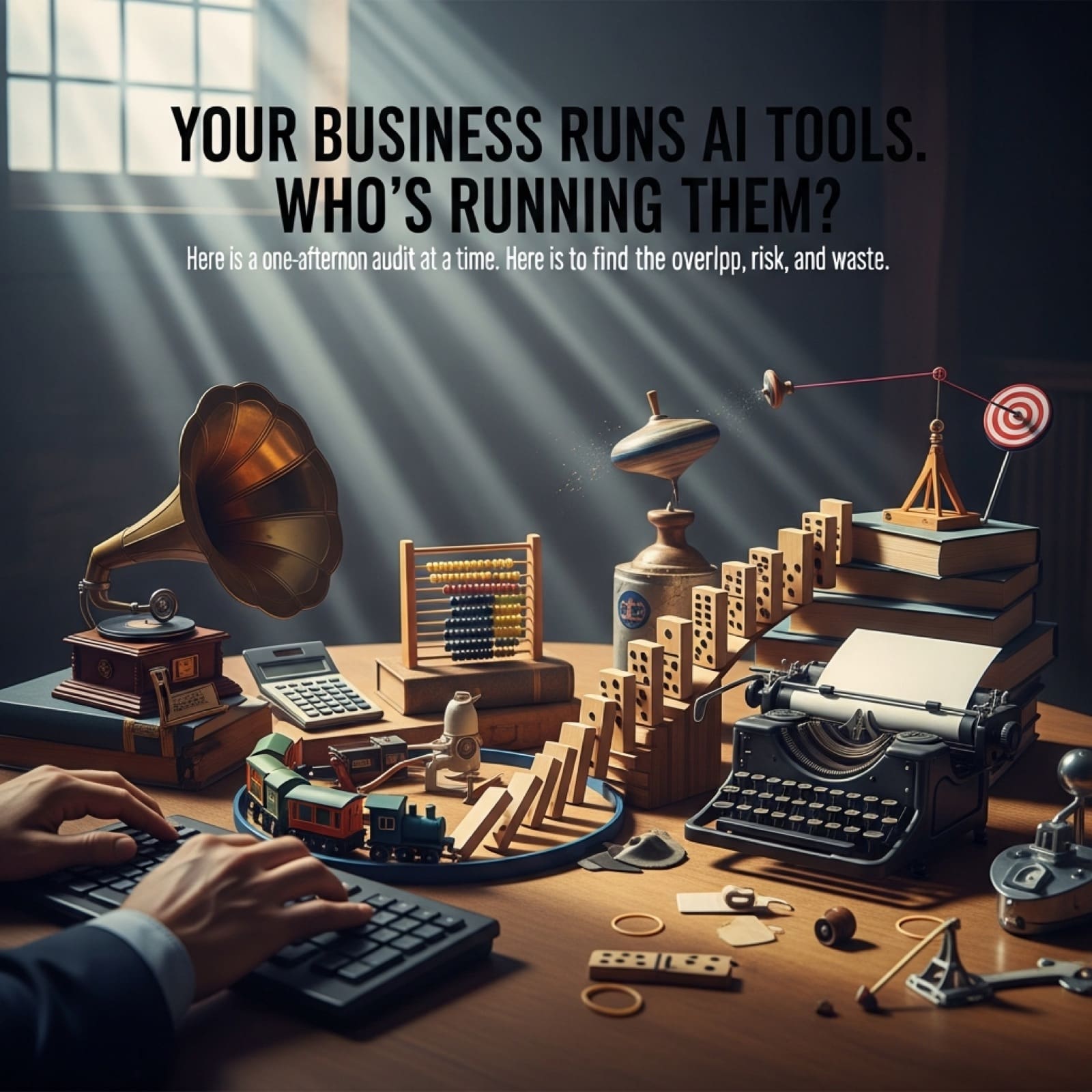
The average small business now runs five AI tools. That figure comes from the Small Business and Entrepreneurship Council's 2026 tech survey, and it surprised me less than what sits behind it.
Most owners didn't choose five tools. They accumulated them.
One showed up inside software you already paid for. Someone on the team started using ChatGPT. Marketing signed up for a writing tool, finance added a bookkeeping assistant, and the scheduler quietly switched on an AI feature you never turned on yourself. Five tools, five separate decisions, none of them made as a system.
That is the part worth slowing down on.
When you adopt tools one at a time, nobody owns the whole. Each one solves a problem in front of one person. Nobody steps back to ask how they fit together, where they overlap, or what you are now paying for twice.
The survey carried good news too. Two-thirds of small businesses using AI report revenue gains, and most plan to spend more next year. So this is not a story about AI failing you. It is a story about AI sprawling faster than anyone is managing it.
Here is what sprawl looks like in practice.
You have three tools that can all write a draft, and your team uses whichever one is open. Your customer data sits in two of them and you are not sure which. One subscription renews every month for a feature someone tried twice in March. And if a client asked you to list every place your business sends information to an AI model, you could not do it from memory.
None of that is a crisis. All of it is drag.
So do one thing this week. Make a list. Every AI tool your business touches, what it does, who uses it, what it costs. You will fill a page faster than you expected, and two or three lines will make you wince.
Then ask three questions about that list. Which of these overlap. Which one holds data I would not want leaking. And which one am I paying for and barely using.
That is an afternoon of work, and it usually pays for itself in canceled subscriptions alone.
This is a different problem than depending too much on one tool. That is concentration risk, one basket holding too many eggs. This is the opposite. Too many baskets, and no one counting the eggs. Both leave you exposed, just from different directions.
There is a temptation to fix sprawl by swinging the other way and forcing everything onto one platform. Resist that for now. The businesses getting the most out of AI, by the same survey, are the ones building deliberately. They fix a real pain point first, then add the next tool only when the last one earned its place. Thoughtful beats tidy.
And give the stack an owner. Not a committee. One person whose job is to know what is in it and say yes or no to the next addition. It does not have to be someone technical. It has to be someone who sees the whole board instead of one square.
What you are really doing here is moving from accident to intention. Right now your AI setup is mostly the sum of small, reasonable choices nobody coordinated. That is how every messy system starts. Not from one bad decision, but from a dozen fine ones that never got looked at together.
The tools are not the risk. The risk is that five of them are shaping how your business runs, and not one person can see all five at once. You would not let that happen with five employees. The AI you have hired deserves the same attention, and right now it is the one part of the company nobody put in charge of.
Free: AI Readiness Checklist
Find out if your business is ready for AI automation. 10 questions, 2 minutes.