Ford Rehired the Engineers AI Was Supposed to Replace
Ford rehired 350 veteran engineers after its automated quality systems fell short. The lesson for anyone automating with AI: know what you're handing over.
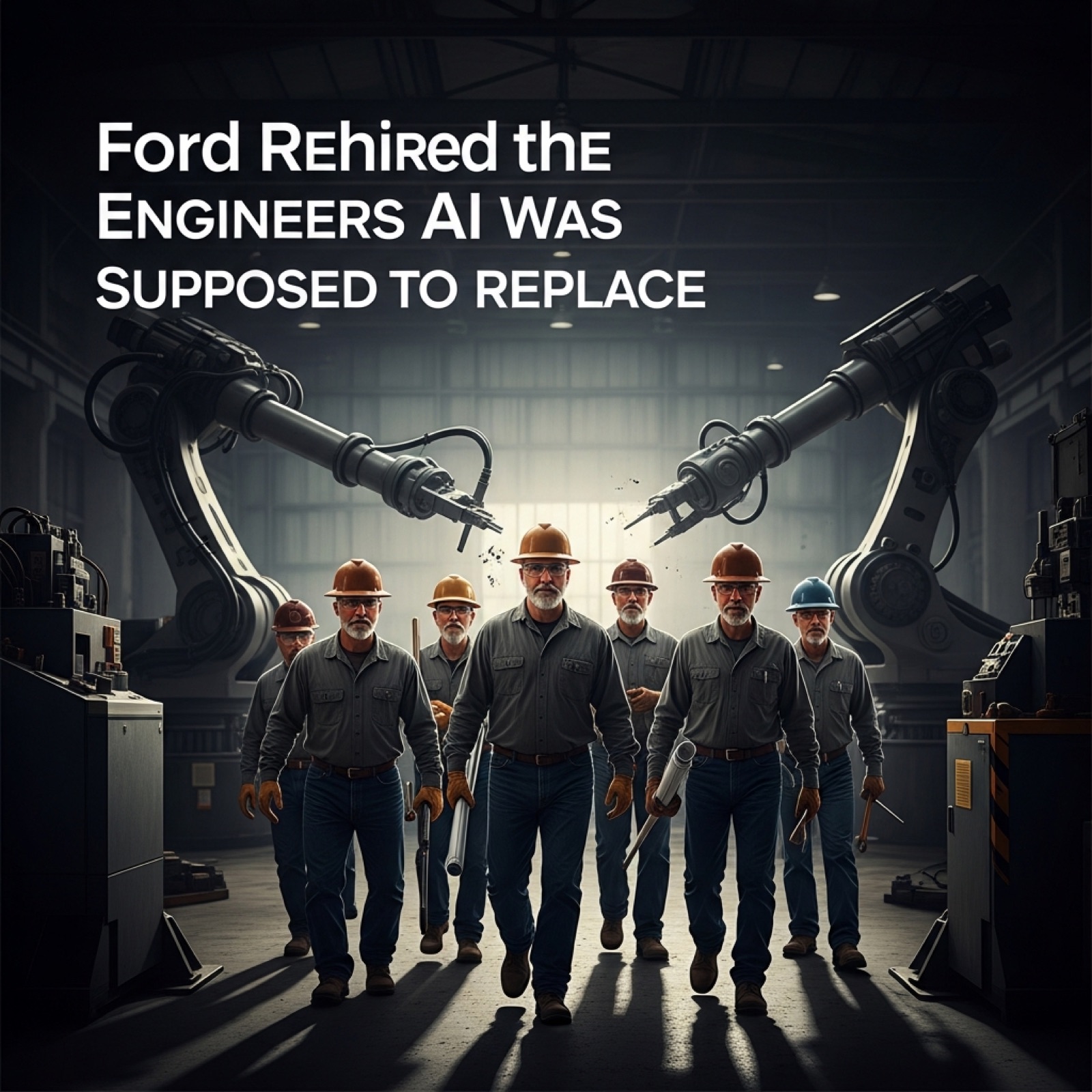
Ford brought back 350 veteran engineers last month. Not new hires. People who had left, or moved on to suppliers, now back on the payroll because the automated systems that replaced them were shipping worse cars.
The company had leaned harder and harder on automated quality checks. The results disappointed. So Ford went and found the people who used to catch problems by hand and asked them to come back.
One of their executives put it plainly. "Mistakenly we thought that by just introducing artificial intelligence and ingesting the design requirements that we had, that that would produce a high-quality product." That is Charles Poon, Ford's VP of vehicle hardware engineering, quoted by Bloomberg.
It might be the most honest thing a big company has said about AI all year.
Here is what I don't want you to take from this. This is not "AI failed, so you can relax." Ford didn't fire the robots and go back to clipboards. The rehired engineers, the ones the company calls gray beards, are there to train younger staff and reprogram the AI tools. Ford still expects a billion dollars in cost savings this year, and it just took the top spot for initial quality among mainstream brands.
So this isn't a story about AI losing. It's a story about AI finding the job it's actually good at.
Think about what the gray beards do. They hunt for failure points before a part ever reaches the plant floor. They know, from decades of watching things break, where a design is likely to go wrong. The AI can check a thousand specs against a thousand requirements in seconds. What it cannot do is sense a bad part coming the way someone can who has seen that exact failure in 2004.
Ford's mistake was assuming the second skill lived inside the first. It doesn't.
This is the trap waiting for every business adopting AI right now, at any size. You take a task an experienced person does, you watch AI handle most of the visible steps, and you conclude AI can do the task. But the visible steps were never the hard part. The hard part was the judgment the experienced person applied without ever narrating it.
Here's where I want to slow down. When someone good does a job, most of their value is invisible. They catch the exception. They notice the thing that's technically correct but obviously wrong. They know which rule is safe to break. None of that is written in the procedure, because they never needed to write it down. They just knew.
AI learns from what got written down. So when you hand it a task, it inherits the documented version and none of the judgment. On the average case, it looks great. On the strange case, the one that actually costs you, it has no idea it's in trouble.
That's not an argument against using AI. It's an argument for knowing what you're handing over.
So do this before you automate anything that matters. Pick the task. Find the person who currently catches the mistakes on it, and ask them one question. What do you look at that tells you something's off? Write down their answer. That answer is the part the AI won't have, and it's the part you need to either build into the process or keep a human watching.
If nobody can answer the question, you've learned something more useful. Either the task is genuinely simple and safe to automate, or the judgment is buried so deep in one person's head that you're one resignation away from a problem no AI can fix.
Ford could afford to find this out the expensive way. They ran down the automated path, watched quality slip, and had the budget to bring 350 people back. Most businesses don't get that do-over. You automate the wrong thing, the mistakes land in a customer's hands, and there's no gray beard on staff to call.
The reframe worth keeping is simple. AI is very good at doing the work. It is not good at knowing when the work is wrong. Those are two different jobs, and the second one is what experience was always for.
Ford paid a lot to relearn that the people who know where things break are not overhead. They're the reason the automation is safe to run at all.
So it's worth asking, in your own business. Who is the gray beard? And have you been treating that person like a cost, or like the thing that makes everything else work?
Free: AI Readiness Checklist
Find out if your business is ready for AI automation. 10 questions, 2 minutes.